
Roof Restoration vs. Re-Roofing: How Do You Know Which One You Need?

Most homeowners do not realise roof restoration and re-roofing are two separate services with very different prices. Restoration repairs and reseals the roof you already have. Re-roofing strips it off and installs a new one. Choosing the wrong one wastes money either way, because a restoration on a failed roof fails with it, and a full replacement on a sound roof spends tens of thousands you did not need to spend. This guide sets out how to tell which one your roof needs.
What's the Difference Between Roof Restoration and Re-Roofing?
The difference between roof restoration and re-roofing is what happens to the existing roof. Restoration keeps it and renews it. Re-roofing removes it and replaces it.
A restoration involves cleaning, repairing broken tiles or rusted sheets, re-bedding and re-pointing ridge caps on tile roofs, then sealing the surface with a protective membrane or coating. The structure underneath stays untouched.
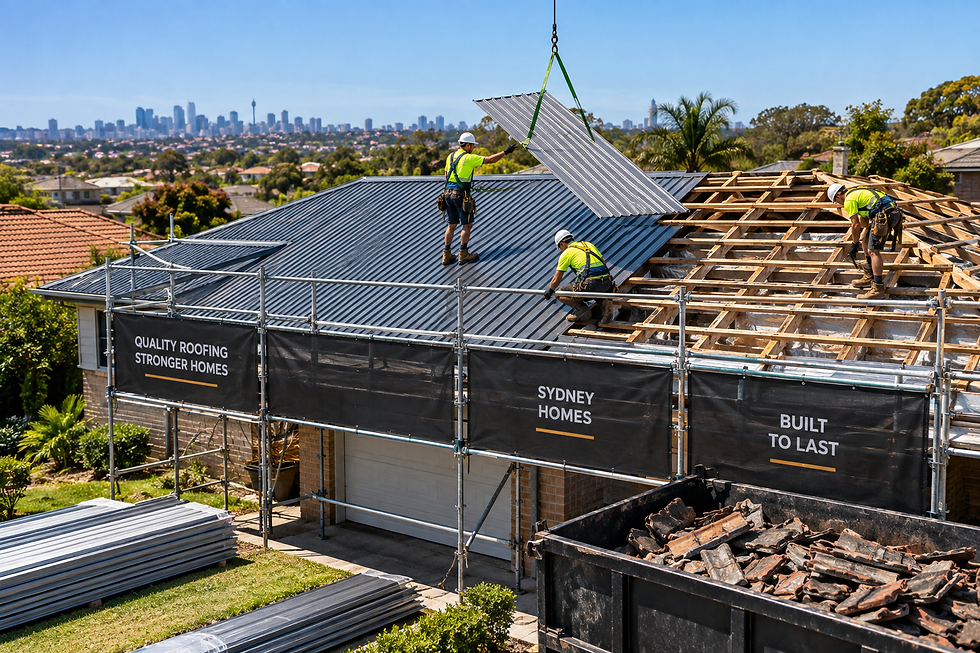
A re-roof removes the old covering entirely, exposes the frame, replaces battens and sarking where needed, then installs new roofing material, flashings, ridge capping and gutters.
Restoration is cheaper and faster. Re-roofing is the right call when the roof structure itself is beyond repair.
When Roof Restoration Is Enough?
Restoration is enough when the roof is worn rather than failed. That covers most roofs between about 15 and 30 years old that have never been restored.
The signs point this way when damage is isolated rather than widespread. A few cracked tiles, one persistent leak, faded colour, surface rust around screws, or crumbling ridge pointing all sit comfortably in restoration territory.
The structure is the deciding factor. If the battens are sound, the rafters are straight and the sheets or tiles are intact across most of the roof, coating and repairing it will hold for another 10 to 15 years.
Budget matters too, and there is nothing wrong with saying so. A roof restoration costs a fraction of a replacement, and buying a decade of life while you plan for the bigger job later is a sensible way to handle it.
If you want the detail on that side, our guides on restoration value and restoration cost go deeper than this post does.
When You Need a Full Re-Roof?

You need a full re-roof when the problems are structural rather than surface level. Coating cannot fix anything happening underneath the roof covering.
Five signs point to replacement:
• Sagging or dipping anywhere along the roofline.
• Rust right through metal sheets rather than on the surface.
• Widespread cracking across tiles instead of isolated breakages.
• Rotted battens or perished sarking found during an inspection.
• A roof that has already been restored once or twice before.
Major storm damage belongs here as well. Hail that has cracked tiles across a whole face, or wind that has lifted sheets and distorted the fixings, is usually a replacement job rather than a patch.
Age is the other factor. Concrete tile roofs past 40 years and metal roofs past 30 are often at the point where restoration is money spent on a structure that has finished its working life. Full re-roofing services reset that clock for another 30 to 50 years.
How Do I Know If I Need a New Roof?
You know you need a new roof when the problems repeat in the same places after being fixed, or when an inspection finds damage in the frame rather than the covering. One leak is a repair. The same leak returning after two repairs is a structural message.
Water stains spreading across a ceiling, daylight visible through the roof cavity, and gutters filling with grit or coating are all worth acting on quickly. So is a roof that has needed patching every storm season for the last few years.
Do Metal Roofs Eventually Need to Be Replaced?
Metal roofs do eventually need replacing, even the well-maintained ones, though regular restoration pushes that date out considerably.
A Colorbond® roof typically lasts 30 to 50 years in a suburban setting. Homes closer to the coast see 20 to 30 years, because salt in the air accelerates corrosion. The sheets usually outlast the paint finish, which is why recoating every 12 to 18 years keeps a metal roof going far longer than leaving it alone.
What actually forces replacement is perforation. Once rust eats through the sheet rather than sitting on it, no coating will bring it back. The same applies when fixings have worked loose so many times that the screw holes no longer hold.
Older Zincalume roofs deserve a closer look, since they have no paint layer protecting the steel once surface corrosion starts.
Practical Considerations: Cost, Time and Approval

Beyond the condition of the roof, three practical differences separate the two services.
Cost difference
Restoration on a standard Sydney home runs $8,000 to $12,000, and Colorbond® recoating starts from around $3,500. A full re-roof on the same home costs $14,000 to $22,000, rising to $46,000 for large or two-storey properties.
The rule most roofers apply is straightforward. If restoration would cost more than half the price of replacement, put the money into the new roof instead. Our replacement cost guide sets out the full pricing picture.
Timeframe difference
A restoration takes 3 to 5 working days on a standard roof. A full re-roof takes 3 to 7 days in Colorbond® and 5 to 10 days in tile.
Weather matters more on a restoration, since coatings will not cure in the wet. Re-roofing carries a different risk, because the house is open to the elements for part of the job.
Do you need council approval?
In most cases, standard like-for-like roof replacement does not need council approval in NSW. Changes to the roofline, height or material can require it in some heritage or bushfire-prone areas.
Restoration is classed as maintenance and does not need approval. Check with your local council or ask us during your inspection, since this is general guidance rather than planning advice.
What about tile roofs?
Tile roofs follow a different pattern to metal. The tiles themselves often outlast the house, particularly terracotta, which holds up for 50 years or more. What fails first is everything around them.
Ridge cap bedding and pointing perish on a 10 to 15 year cycle. The factory coating on concrete tiles wears off within 15 to 25 years and leaves the tile porous. Battens and sarking underneath quietly reach the end of their life at 50 to 70 years.
That is why so many tile roofs can be restored two or three times before replacement becomes the sensible option. When the battens go, though, restoration stops being possible regardless of how good the tiles look.
Why a Professional Inspection Settles It?
An inspection settles the question because the deciding factors are not visible from the ground. Hail-damaged tiles often look fine from the driveway while carrying hairline cracks that leak a year later. Valley irons corrode from underneath. Battens rot quietly under sound-looking tiles.
We get on the roof, check the ridge caps, valleys, flashings, fixings and sarking, then tell you which service your roof needs and why. Sometimes that is a restoration, sometimes a re-roof, and occasionally it is a single repair.
The inspection is free and comes with a written scope either way. If you would rather know what to expect before booking, our guide on free roof inspections explains what happens on the day.
Restoration vs Re-Roofing FAQs
What's the difference between roof restoration and re-roofing?
Roof restoration repairs, cleans and reseals your existing roof to extend its life. Re-roofing removes the old roof entirely and installs a new one. Restoration is cheaper and faster, while re-roofing is the right call when the roof structure itself is beyond repair.
Do metal roofs eventually need to be replaced?
Metal roofs do eventually need replacing, since even well-maintained Colorbond® and metal roofs reach the end of their lifespan. Regular restoration and maintenance can extend that significantly, often by decades.
What are the signs I need a full roof replacement rather than restoration?
Widespread rust or rot, sagging areas, major storm damage, or a roof that has already had multiple restorations are signs a full re-roof is the more cost-effective long-term option.
Do I need council approval to replace my roof?
In most cases, standard like-for-like roof replacement does not need council approval in NSW. Changes to the roofline, height or material can require approval in some heritage or bushfire-prone areas, so check with your local council or ask during your inspection.
Find Out Which One Your Roof Needs
You do not have to work this out on your own, and you should not have to guess based on a photo from the ground.
We inspect the roof, give you an honest answer on restoration or replacement, and put a written scope and price in front of you. Book your free inspection or call 0430 847 744 to arrange a time.


Comments